
[This is a first draft, with intentions to be cleaned up for submissions.]
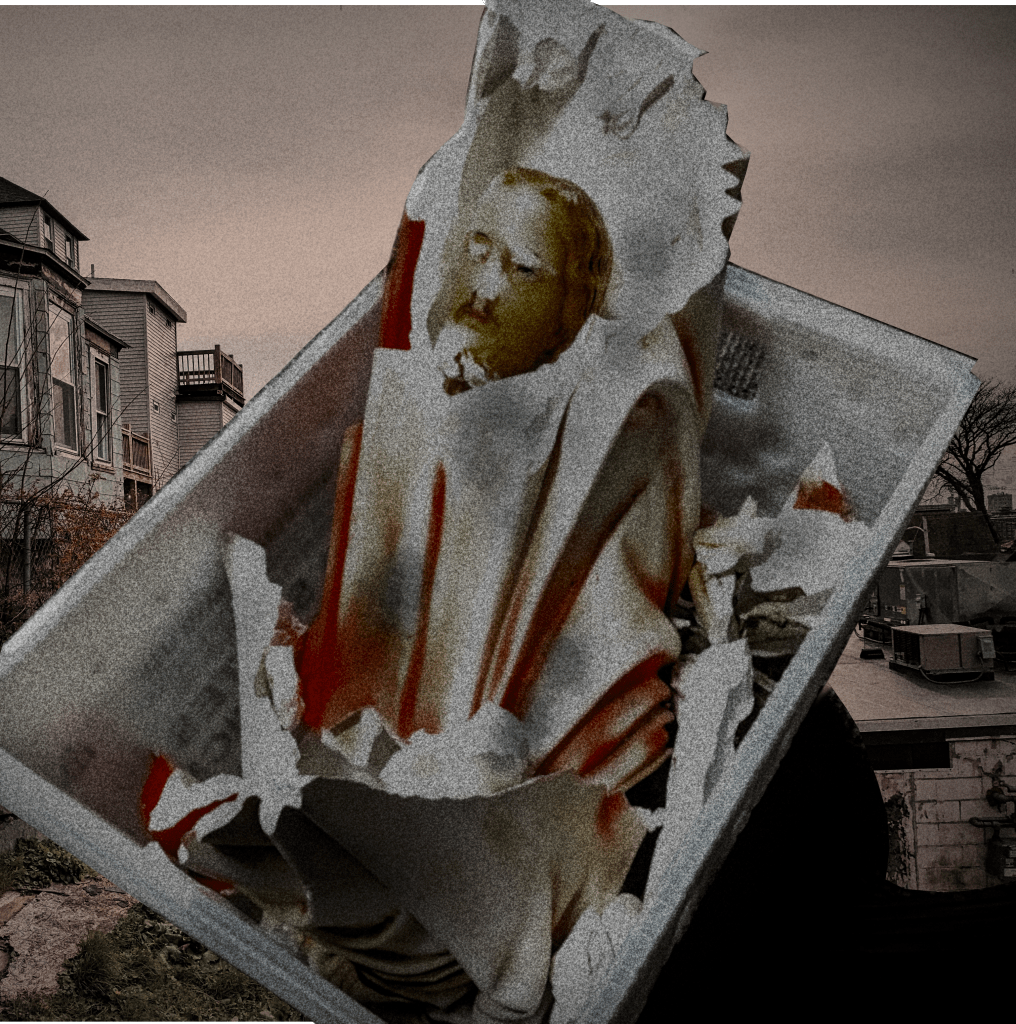
You’ve been dreading having to work on anything in the server room since you landed this gig. You could feel the anxiety rising behind your sternum, already heightened from all the feigned-knowing nods and deflective smiles you’d been pulling throughout the day, when The Deacon first brought you down to see it during your interview. When he asked if you were familiar with the Ecumenical Language that the blinking mass of donated PCs and network switches were blasting packets to each other in, memory of the third bullet point under “SKILLS & PROFICIENCIES” on your IT job resume stopped you from instinctively answering honestly. Instead you nodded and referenced the phantom office of the second bullet point under “PRIOR EXPERIENCE,” trying to imbue your voice with the right tone of world-weary levity while struggling to lower your heart rate.
So now here you are. The server room looks the same as it did that first time you saw it, and the identical inch-deep layer of congealed dust on top of the relatively little exposed surface area leads you to believe that it probably hasn’t been touched since however long ago that was. Rat’s nest, or a nest of some sort, except less homey. Nobody could ever sleep here. The blinking is incessant, for one thing. Indicator lights flashing patterns that have no consistency across ports, telling of something being connected to something, perhaps even successfully. But you could already tell by looking that everything was connected to everything else; cables, up and down the Cat. scale, hung low overhead and stretched taught like tripwires along the little pathways that had been burrowed between Jenga towers of hardware by whoever had last gotten lost in here. You dread finding their body moldering somewhere as you turn corner after corner trying to navigate your own way out Wouldn’t be the first dead thing you found in here. Beyond the masses of hollow insect exoskeletons and switches that stopped years ago and now just served as piled-up pedestals for other switches, the smell of dead rats and the copralite they’d left behind is overwhelming in some areas. You’ve never be as deep in before as you are today, but even on your shorter trips you’ve yet to go back upstairs without having to pull broken cobwebs off of your face.
“EXPERIENCED IN A WIDE VARIETY OF CODING LANGUAGES, INCLUDING: BASE; HIGH; LINUX REMNANT; C; ECUMENICAL; DIDEROT; ARTHROPOD; HOMOLOGOUS; PSYCHOANALYTIC; C-; APOPHATIC.” None of which is true. This is all your own fault.
The Service is supposed to begin at 4:30pm. You have the chunky little ThinkPad The Deacon assigned you hooked into a switch more or less at random, and are avoiding looking down at the time in the corner of the screen as you type:
“sudo apt-repair /+cross : Christianity and the origins of psychoanalysis [origin of the subject = subject], [_]must be sublimated / brought to heel for the continuance of the holy institution: the confessionary / the couch: the larger structure into which [_] are plugged ; which keep it going at the expense of / which generate [a lack of (-) / superabundance (+)]/
(-) individual fulfillment
(+) subordination
(=) batteries / electric sparks directed by the coding language that knows where to plug it in and plug it up for the networked purposes that have little regard for its constitutive parts beyond how they ++ RAM”
You hit Enter and are confronted with:
“Reading package lists… Done
Building dependency tree… Done
Reading state information… Done
Package psychoanalysis is not available, but is referred to by another package.
This may mean that the package is missing, has been obsoleted, or
is only available from another source
However the following packages replace it:
Taylorism-Ford
E: Package ‘psychoanalysis’ has no installation candidate”
You purse your lips and moan silently through your nostrils. You’ve lost count of how many dead ends like this you keep running into trying to get things back up and running. Your upper lip is slick with sweat that’s starting to bead on your brow as well, and you worry about it falling down into the cracks of your keyboard and shorting something right in the middle of (what would be a miracle in its own right) you finally, and entirely accidentally, hitting upon the right string of symbols to make the AV installation upstairs functional again. You gulp that stress fantasy back down, telling yourself to get back to it, noticing how much longer those anxious reveries are lasting as your failure to fix things goes on. This is a treadmill, like a nightmare that startles you harshly awake on the first day of school, and you’re running as fast as you can to end up further back than where you started.
The Deacon hasn’t given you enough time to prep for The Service. That much is as usual, you’ve frankly come to expect it. But a system failure like this wasn’t expected, and the amount of time you’ve already spent trying to isolate what is even going on has cut the time you usually have to get everything set up almost in half. You sharply inhale, steeling yourself to check the time:
It’s already 2:15. You screw your eyes shut and put your head in your hands, not for the first time today.
The problem, to the extent that you can identify it as such (you’ve gotten deep enough into several of the Constitutive Tangents in the network’s code to have had your previous assumptions about its architecture thoroughly exploded – one of the many anxieties now fighting for your fractured attention is a creeping horror that perhaps this isn’t a problem in the first place, but somehow an intended result) manifested first during the sound check this morning. You’d already had to reposition the usual microphone setup after The Deacon informed you that there would be a visiting priest delivering the sermon, but that he would still be giving the first reading and the prayers of intercession, so you’d need to grab the extra lavalier and plug its receiver into the auxiliary XLR that was buried in the back of the rack in the sacristy. You hate having to do anything with the auxiliary XLR because its position is difficult to reach, pushed deep behind a cascading mass of other cables, and immovable because whatever genius did the original installation apparently came from a culture that had yet to discover velcro so had zip-tied everything firmly into place. When you came back from the equipment room with the extra lav kit and managed, after no little struggle, to get it plugged in, your eardrums were almost shattered by the immediate, piercing explosion of a thousand unending screams coming over the church speakers.
At first you didn’t react. Your body, halfway through a curtain of heavy cables, was crouched immobile to avoid avoid dropping your vulnerable stomach into a bar in the rear of the rack you were leaning over. Your first instinct was to not change position no matter what to protect your guts. The screams seemed never to peak, as if you were listening to a sea of sufferers so vast that it was impossible to tell when one left off issuing their mortal complain and another picked up. It could only have taken you a few seconds to try unplugging the receiver, which somehow cut the noise, but your ears were ringing for a good ten minutes afterwards.
You’d never heard that sound before. If you had been standing near one of the speakers in the cathedral when it began, you would probably have suffered permanent hearing loss. At least you knew what to do the second time, when you tried plugging the extra receiver into the main XLR port and were blasted by the same cacophony yet again. Then once more when you plugged the usual receiver back into the main port with the same result. You’d just used that same configuration this morning when you sound-checked with The Deacon; what could have happened between then and now to change things so drastically?
If the installation had been analog-only, maybe you would have figured this out by now. As you ran through all of the troubleshooting you could do in the cathedral itself, though, you were slowly forced to the sinking conclusion that the issue wasn’t with any of the analog equipment. That meant the problem must be located in the much more difficult part of the setup that ran over IP, mediating between input and output down in the basement like the messy unconscious of the process by which unsuspecting homebodies watch livestreams of church services. Your immediate instinct was to cancel that evening’s service, but you remembered how apoplectic The Deacon had been the last time technical difficulties had delayed a church event, and how frightened you’d been to see that unexpected violence bursting forth from his usually calm demeanor.
The Deacon looks like somebody you think you met before, but maybe it was just somebody you saw on TV. He has a standard-issue Ken Doll physique, just a little older and paunchier, and a face like a half-remembered boxer hound with unnecessarily streamlined glasses. His salt-and-pepper hair is receding dramatically, and no matter how hot it gets you’ve never seen him fail to wear a suit jacket. You know your contract is somewhere in his office, in one of the dozen or so wooden filing cabinets that line the Eastern wall. When you saw him pull a drawer out once, you wondered how long it would keep going for – if it would ever stop or if he could’ve walked clear across the room still grasping its handle. You’re thinking about your contract now because you’re hoping, desperately, that it’s close to being up. The next time you see him, you’ll have to ask to read it again. You’ve only ever done that once, and The Deacon made it very clear to you that he was on a tight schedule and didn’t have much time for slow readers, so you can either sign now or leave.
There are portions of the cathedral’s network that are based heavily on the Liturgical Calendar, which has resulted in you having large parts of it committed to memory (the Calendar, not the network, sadly). But even so, you weren’t prepared for a Service today like the one The Deacon dropped on you. A regular Service, yes, but not a High Mass with expectations for full-pew levels of attendance. When you asked him what this was in observance of, being careful not to imply or indicate by your tone of voice that you were questioning him, The Deacon replied that it was a new Feast Day that had just been decided on by the Secretariat of Divine Worship of the Conference of Catholic Bishops. It was for a Martyr whose name you didn’t recognize but pretended to because The Deacon pronounced it with such authority.
It’s not unusual, though, for new martyrs to be announced seemingly at random. After periods of mass death, you reason, it probably takes time to take full stock of all the people who perished for the faith. But there’s also the complicated matter of doctrinal disputes left over from the schism in the Diaconate being resolved recently by an unexpected reversal on the question of Martyrability beyond the Benedict Compound, meaning all those who were killed are eligible for Martyrdom whether or not they made the pilgrimage. You had avoided asking The Deacon, when he informed you of it, about whether or not this decision put the Diaconate in conflict with Papal opinion on the matter. Back when I knew you, this was exactly the sort of criticism you would never have been afraid to voice, but these days a misunderstanding of this sort of important bureaucratic/theological nostrum would make you look too much like a backwards rube for you to risk asking it in a professional context.
Beyond that, it’s so difficult to know, anyway – the reforms that came out of Vatican IV were byzantine and occasionally, you thought, contradictory, referring to other documents you had never seen and that you suspected nobody else had, since nobody could seem to tell you when Vatican III had taken place, or if it had at all. You heard a congregant once muttering under his breath, far in the back of the cathedral where he probably hoped nobody could hear him complaining to the woman he stood beside, that The Deacon was reading from the new liturgy when, for all anyone knew given the state of internecine communications (or the lack thereof), Vatican IV could have been a committee of one person. Perhaps it never even happened and various churches were spreading rumors that it had as a way to institute reforms to suit their particular theologico-aesthetic sensibilities.
So much of the hardware down here is absolutely archaic, so many donors that are just obsolete and barely holding together, that there isn’t even really much theological consistency in the first place. There are whole servers running on open-source operating systems with referents in the Ten Sefirot, making them not only unstable in their own right but liable to fail entirely when it comes to communicating with the proprietary servers that the AV hardware is networked through. You’re trying to ping one of them now, wondering if you had missed a firewall update somewhere along the line that you were supposed to perform manually, and if that could explain the camera failures.
Part of the issue lies in the core difference between the mythostructure informing the network’s cosmogony and the one that, no matter how far you come away from your childhood and the various religious dogmas of our people, still informs at a fairly deep level your own cultural consciousness. You know enough to know that probably you can never fully get away from it, but the extra seconds it takes to understand the grammar of the arguments you’re working with is costing you precious time. Duality you can understand instinctively, the essential split defining the subject from the moment it can be thought of as such. A binary structure like that would make all of this easier. It’s this Trinitarian stuff that throws you off, and trying to keep track of the partitions between that Divine figuration and the more lacking mortal one that’s easier for you to understand but only makes up part of the organizing logic you’re trying to engage becomes increasingly difficult to parse the further and further you get and the more changes you make.
“ping 1.11.1/5”
You hit enter. “PING 1.11.1/5 56(84) bytes of data” appears beneath the line you entered, and then your cursor drops down to the next row and stays put, blinking, waiting along with you, still as you are but probably not half as upset. No response. If that’s the case, though, why are you able to access the security camera system through that IP address the same way you always have? (Routing them through the same server isn’t exactly best practices, but you were trying to avoid coming down here to the server room and encountering exactly the horror you now are.)
The four grainy, square feeds take up nearly all your laptop screen for a moment while you check to make sure that’s still the case. Confusingly, it is. The first camera shows the narthex, long, slim and dark. You can see what little light comes in through the small, square windows over the doors (those massive, heavy doors – even putting your whole body weight into pulling on their wrought-iron handles, you’ve never been able to open them, and you’ve come to suspect that the time you heard their ponderous closing thud behind you on the day you arrived here for your interview is the last time you’ll ever hear that sound), reflecting off the basin of a large metal bowl holding a tall candle, unlit, in the center of the tiled floor. It wasn’t there yesterday, and you can only assume it has some special role in tonight’s Service.
The second camera feed shows the Cathedral’s vaulted interior from a somewhat awkward angle, the camera stuck up underneath the choir loft and positioned so that one of the room’s sixteen marble columns obscures the view partly no matter where you move it. But still, if you swivel the camera along the P-axis of its PTZ, you can get a clear enough view from the three windowed entryways out from the narthex all the way up between the pews and to the altar. If only the overhang of the choir loft wasn’t in the way, you could even get a good shot of the Ascension Wall, the great clay Christ affixed to the stone facade however many centuries ago in his attitude of beatific nonchalance.
Save the candles lit for the dead, too many to count lining both lengthwise insides of the chamber, the cathedral is dark. Still and sanctive, exactly the thing people who came in off the streets to pray had wanted back when they still did that. Looking at the still surface, you would never guess that underneath it it is the profusion you now sweat within, except that the low quality of the cameras combined with the blackness of the chamber give what surfaces you can make out the writhing, swarming appearance of being overcome with bug-like grain, its particles straining to enact entropy and fly apart at any moment to disrupt the placidity of the empty space.
If that were to happen, perhaps the room would end up looking like the last feed, which is almost entirely a vibrating black. You know, though, that this isn’t a problem with the feed. It’s just the view from the back door out into the alleyway where the dumpsters are kept. Or where they were last known to be kept, since they aren’t visible from this camera anymore, and bags of trash now pile up in a room that used to be a food pantry for the homeless, quarantined off from the rest of the building and accessible only by way of a makeshift garbage chute in order to keep the smell contained. The only point of light in the image is a single dim Christmas bulb, the last one still working on a string put up well before you got here. The security cameras only take black and white video; you’ve always wondered what color that Christmas Light is.
You wonder all the things you’ve already wondered over and over again today. Is there a different VLAN you’re forgetting about? Are you using IPV6 when you should be using IPV4 to account for the older gear? All of which are issues that, were they the case, could be solved from where you are now, and which you already would have at least discovered was part of the problem. But, even with as much Audio and Visual information running packet-distributed over IP, there still needs to be a physical cable connecting Point A (the audio board) to Point B (???), and that cable is the skinny CAT5E ethernet cable that’s lying wrapped around your left ankle, down by the bottom of the stack of dead switches you piled up to sit on top of when you parked yourself here (my god, how long has it been?). It has notches along its corrugated white length in black sharpie every few feet, where you made sure to bend down and mark it as you followed its snaking path like a bread crumb trail down from the choir loft where the makeshift “control booth” is tucked behind the organ, all the way down through the floor, across the ceiling in a zip-tied bundle with a dozen other cables, and down the stairs from the basement as it struck off on its own path to worm through the stacks of dessicated hardware. You’ve avoided doing the obvious, just continuing to chase up its length until you find out what, exactly, it’s plugged into, because you know that won’t necessarily bring you any closer to the answer you’re looking for and could waste a significant amount of time. You’ve officially run out of other ways forward, though, so, breathing in deeply to steady yourself, you shut the ThinkPad on your lap, unplug the network cable from its side, and stand to untangle your foot so you can take hold of the guiding cable’s length and continue to follow it through this mess, gripping it probably more tightly than you need to since it’s not only the last way you have to find your way back out if you get lost, but because it feels in some way like the last thread tying you back to your sanity. Or, at this point, whatever this is that’s passing for it.
*
Like you, I wasn’t raised in the church, so I come to its languages and rituals as an outsider. We weren’t even raised in this country, or at least it wasn’t part of this country when we were being raised here. You are no less an outsider culturally from this place where you now find yourself stuck, but your family had always had land and property in a way that initially intimidated me, and they maintained that through all of the changes and convulsions until the final one when there was no reason to hang onto it all anymore anyway.
Like most people of your station, you started out learning the skills that eventually got you this job for purely artistic purposes. That was how we met. I didn’t understand your art at first, didn’t understand the dramatically unbalanced input-to-output ratio you maintained. Why did you spend so much time reading and researching and taking mountains of notes that you never actually seemed to begin working? After a childhood of steady toil, it took me a long time to recognize your ceaseless preparation as the product in itself, and my own frenzied productivity as legitimate labor despite the pleasure I took in it. After these realizations had settled in me, I think I understood your art even better than you did.
Still, even though you never produced in a way that was legible to them, you maintained a certain intimidating standing in the circle of runaways and malcontents that we found each other through in what was then the Capital City. Maybe it’s because I eventually realized, in a way I think you did too but never acknowledged, that this air of authority had as much to do with the disavowed habits your family’s money had bred in you as it did your incisive ways of thinking that we could become as close as we did. It surprised all of our mutual friends, given the contrast between my taciturn, uneducated affect and your own.
I think you took some pleasure in that surprise, but you knew well enough by then to either hide it or feign an irony that wasn’t actually there. I, on the other hand, responded to it as I did most things: with a quiet avoidance that tried to indicate there were more important matters for us all to be worrying about. Which was honest enough as far as it goes, but came to mask the fact that, for me, eventually, there was no matter more important in my life than you.
We moved into a shared rental flat in the textile district about a year after we met. Initially a marriage of convenience as rents rose across the city, alongside taxes to pay for increased conscription and deployment costs and, possibly as a corollary, something resembling inflation that the sort of people we were friends with endlessly argued about the least-wrong terminology for, our lives became increasingly intertwined over the next two years. Especially as your (and, resultantly, my) involvement in independence work deepened. Strangely, that shared commitment seemed to entangle us more inextricably than our by that point longstanding sexual involvement had. Knowing how each other reacted in the back of a police car somehow felt more intimate than knowing each other’s physical appetites (yours variable, sometimes nonexistent and sometimes verging on insatiable in a way I was so deeply attracted to – coming again and again in my mouth and hands on the tattered sofa in fading afternoon light through our stained windows before, still not satisfied, you would leave to find somebody with less work that had to be finished to spend the night with). But always we returned home together, and slowly as the situation became more and more dissolute at the macropolitical level, our hermetic home life became as ordered and neat as that of two destitute artists could be. We learned each other’s habits, opinions, preferences, avoidant tendencies, favorite foods – the small, personal details that we thought could be anchors amid the turbulence, tiny but stuck fast like push pins to hang onto in a maelstrom. We were, in other words, still young enough to believe that such things could remain unchanged, or at least under our individual command, despite what wider currents might buffet us. You know better now, but until this moment I didn’t make it long enough to find out with you. And until this moment, I didn’t think I could know anybody better than I knew you then.
*
There is no map for the territory you’re trying to navigate now. The installation upstairs you at least have documentation for. Much of that you had to reverse engineer yourself, writing it out longhand on graph paper as charts showing input and output, IP addresses, and other necessary information you discovered by slowly filling in the outlines of the enormous lacuna that had been left for you to operate. You’ve never shown The Deacon those charts, as he doubtless would have criticized them as being part of your purely pragmatic understanding of the doctrine. With a superior sort of smile, he would say that you missed the subtle beauty of the arguments, the human pleasure they could generate, the link, however gossamer, to actual divinity. Your understanding, contrariwise, was thorough but rooted only in the outcomes that could be generated in the physical and digital planes rather than on the spiritual. You reason silently (and I, also silent, reason along with you) that The Deacon is mistaking precisely his feeling of superiority, an outcome very much on the physical plane, for something more transcendent than it is. Perhaps you realize this and he does not because you yourself are the necessary, disavowed piece of the puzzle that allows that feeling of superiority to be generated. Pointing this out, though, could endanger your job, and so you keep quiet when The Deacon makes jabs like this.
You’re thinking about this as you walk, as quickly as you can while still treading carefully with your computer tucked up under your arm, because you’re more afraid than you care to admit that the problem you’ve run into with the network here is similar. Which would be to say that the network has become such a complicated hodgepodge of languages and thought structures that the problem resulting in the deafening noise you heard is a lack generated by exactly the framework that wants for it, which would make it a necessary or constitutive lack and therefore irreparable on its own terms. The only solution, which you don’t have the time or the know-how for, would be to nuke the entire network and start from scratch.
You wince slightly as you have that though; that last part hits a bit close to home. And then you turn the corner and, my dear, dear, friend: there I am. Maybe not the absolute last person you were expecting to see, but probably pretty low on the list. You stop and stand stock still. We both are silent,
[ ]
and it briefly almost seems the whole room is as well.
[ ]
Can you see me? (Could you ever?) At first I’m not sure. In this decrepit labyrinth, there is enough to look at and be shocked by that I can’t tell if you’re looking at or through me. But then, quietly, you say my name, and I know you’ve noticed me. I am so new to being manifest in the way that I am that it’s an experiment on my own part to respond by whispering your name back to you.
<<Are you real?>> you ask me after a moment. That I don’t know how to answer shouldn’t catch me by surprise as much as it does.
<<I don’t know,>> I say eventually. <<But I’ll tell you if I find out.>>
<<How are you here?>> To which there’s only the same answer. And then, softer, <<I missed you. Or… I miss you.>>
<<I do, too,>> I say, meaning it both ways.
[ <<this can’t be…>> ]
Somewhere nearby, a wheezing cooling fan starts to spin loudly, and this brings you back to the time crunch you’re under.
<<I’m sorry,>> you say breathlessly, turning back to me. <<I’m… I’m sorry, but I have to–>>
<<I know,>> I say, because I do. I don’t know how I know, how I’m aware of everything you’ve been dealing with since last you saw me, or of how you feel even now moment-to-moment. But I know it all just as clearly, or as murkily, as I do my own emotions, so you do not need to explain yourself to me. I think I have somehow conveyed this all to you, for we take off running together through the path you were on when you found me.
*
It’s funny how much I once craved exactly this. To know what you were thinking. Your moodiness, your self-acknowledged difficulty, could express itself sometimes in long periods of silence that I couldn’t stand. It felt, I told you, like you were shutting me out aggressively. It wasn’t that, you would respond, but you just couldn’t tell me whatever it was right then. In those moments, all I could have asked for was the access I have now.
How or why I have it, I still can’t say. In the brief time that I’ve been here, the time before you turned the corner and recognized me into existence, I’ve considered as many different possibilities as I had space for in a mentality so crowded by you. Most persistent has been the fear that my initial self-reaction – that I am obviously now a spirit raised from the dead to correct a ceremonial failure in my burial – is a mistake based on an overly familiar fairy tale, a bedtime story you and I were both told as children (me by my mother, you by the Christian missionary your parents hired as a live-in tutor) which would make some sense on its own terms given my lack of any burial at all. Perhaps, instead, I’m only a figment of your imagination, an amalgam of your recollections of me misrecognizing itself as myself just as you are. It doesn’t explain why I’m here in the first place, but it accounts as well as the ghost story for the odd sort of remove I feel from my own emotions, encompassing as they do both mine and yours at once, with both feeling mirror-reflected, without immediacy.
Here is what you’re thinking now:
<<It doesn’t make any sense, but so doesn’t any of this – nightmare, nightmare, why did I have to live? I could still die, though, if I wanted to. And now with him back, if he is – here he is, there – I don’t want to be seen like this, I’m so ugly, I’m trying to problem-solve, watch me being smart and when I figure it out I won’t be so ugly anymore: if the signal is getting lost between the microphones and the output, it could be anything in the chain between those two; but I’ve confirmed it isn’t any of the cabling running into the speakers out of the Distribution Amps upstairs, so it must be one of the X number of Y pieces that carry the sound from the mouth to the mic to the abcdef to the audio mixer to the ghijk to the speakers (take a breath, hold the cable, end the sentence, use a period). god, I’m sweaty. why is he here to see me like this? I don’t want to be seen. I thought I was the only one who made it; I don’t want to be here anymore, please let me ____________>>
You think all of this so quickly I barely catch most of it. What I do catch is how tightly knotted the pain in you is, rope moldered over after years of water damage so that it isn’t even a knot anymore; it’s just one giant mass never again to come apart. You are so afraid that it will never come apart. The pain I was expecting; what I wasn’t is the fear. You always seemed fearless to me, and maybe you still would if I didn’t know better now. More painfully, that fear makes you angry: angry at me. For being here, for seeing you, for having died when you couldn’t or for having survived as who I was when you lived through the interim into who you are now. If you could make it so that I wasn’t here, turned a different corner or undid the line of code that produced a bug like me, you would. This you would never tell me aloud.
Slowly, I think, my heart is disintegrating. Was I foolish to hope you would be happy to see me? Not even “hope,” really, just assume. I assumed that your love for me had lasted, and would emerge with childish simplicity when we were reunited. Please, please, turn around and see me again. Instead…
[ <<I (want/try) to say something to you, but…>> ]
We must have come at least half a mile away from where we met by now. You didn’t even know that the basement beneath the cathedral was so large. The server room must take up fully twice as much space as the aboveground structure. But as we go on, tracing the cable’s path, the environment around us starts to change. A sense of proximity creeps in around the edges until you notice some of the switches are dusted by, and eventually recessed into, what looks in the dim green light like dirt. The earthen walls close in on either side, and now the hardware is becoming sparser, half-submerged, and connected tenuously by dusty cables embedded across long patches of dirt like sinews. Almost none of these are blinking; are any of them even working?
Still we follow our cable, running along the center of the floor, only occasionally intersecting with others, like the one right path drawn through a puzzle book maze after a dozen false starts. Just as you start remembering the paperback maze books your father would bring you home from his business trips to the Capital, you notice something far up along the wall on our left. A recess, but one that doesn’t seem to be holding any equipment. Then, to our right, slightly further down, is another. They continue to appear intermittently, increasing in frequency as the switches and servers decrease, until one is finally close enough for you to see what’s inside. When you do, without thinking, you turn to me with your eyes wide and heart beating even harder than before.
<<It’s->> you start, and then briefly can’t go on. <<I think these are…>>
They are. Inside each of the recesses is a rotted corpse, wrapped in linen that’s probably chewed through at this point, buried with notes from loved ones tucked into their embalmed hand. We know this without seeing it for ourselves because that is the burial practice of our people, and we are now, somehow, in a catacomb surrounded by the bodies of our countryfolk.
The feeling that overcomes you is difficult to convey. Fear, yes; we both heard enough ghost stories before bed as children to have a healthy aversion to being surrounded by the dead. But there’s a reverence, too, the sort of thing you imagine The Deacon expects you to feel in the cathedral above but which you never have. How long, we wonder, has this catacomb been connected to the cathedral’s basement? Probably it predates the cathedral itself, from back when ours was a country that had maintained some prosperity even after the contraction of the imperial scope it had three centuries earlier, carrying on cultural rites like burials and weddings and coming-of-age dances, all the things you’ve tried not to remember since you got this job to keep the hole in you their absence left in you from becoming overwhelming. That sorrow is the other valence of what you’re feeling right now, being so close to what you’ll never have again.
You know you must keep going, but it’s hard not to stand in wonder and fear, precious seconds slipping away as you try to make out how high the walls stretch above us. The light dies out before it reaches wherever the ceiling might be. Our ancestors rise up around us far beyond our vision. When slowly we begin to walk again, still following the cable you almost dropped when you realized where we were, the recesses become denser and denser. The floor seems inclined, and we are moving deeper and deeper into this massive tomb.
A bluish glow starts to creep in around the edges. You notice its luminance increasing, but can’t find the source until, at last, we come upon a bend in the path that shows an alcove dug deep into the wall at its outside corner. The blue light pours out of this space, and the cable in your hand leads right inside it. You dash forward, turning into the entrance. Inside is a small stack of dead switches underneath one of the oldest-looking servers you’ve ever seen. The ethernet cable is plugged into some arcane converter to run into a line of ports whose type you’ve never even seen before, and there are two similar converters with ethernet cables running out of them. One of them goes up the wall of the alcove through a hole in the ceiling, but the other, miraculously, has a loose-ended RJ45 end lying in the dust at our feet. For a moment, you allow yourself a pang of hope that there’s a way to work this all out after all.
I look around as you dust off the cable and plug your laptop in. Your assumption upon entering had been that the hardware in here was the source of the blue glow, but it isn’t. All of the LEDs I can see appear dead, and the walls and ceiling around us are, I’ve noticed, covered in what must be some sort of fungus. It certainly isn’t regular earth like the walls into which the catacombs outside are built, its texture is mucoidal and slick. I think in areas it’s writhing slowly, but it’s hard to see through the glare of the light, which I’m becoming convinced must be some sort of bioluminescence that this mold (if that’s what it is) is giving off. There’s a patch nearby me where the substance appears to have congealed enough to push outwards, forming a sort of knob that looks liable to snap off. Without thinking, I start to reach out for it.
<<Hey,>> I say, absently – for a moment, I can remember what this felt like; I’m interested in something and want to show it to you – <<Do you see–>>
<<Huh?!>> you say. When I turn, I see you looking at me blankly, your brow sweaty, hunched over to plug the loose ethernet into your laptop. <<Can you just- I need a second here, I think this is it.>>
I don’t say any more. You are too fried right now to hear me anyway. I turn back and am looking at the walls again when, almost simultaneous with the sudden panic I feel shoot up in your chest, I hear you shout:
<<Fuck! Oh, fuck!>>
I am at your shoulder in a heartbeat to see what you’ve seen. On the screen of your laptop, in the program window of the unsupported port of OBS you’ve managed to jury rig to reasonably simulate its original purpose, you’re finally (finally, finally) getting feed from the PTZs upstairs. They’re showing pew after pew already full up with congregants.
The computer’s clock reads 4:17. The Service started long ago, and you haven’t been livestreaming any of it.
Your mind races. You hit “record” in OBS, thinking without thinking that maybe salvaging some portion of the event is better than nothing, but you know that it’s already too late. It won’t be enough. Your body starts shaking involuntarily, all the pressure of the day finally overloading you in the face of its ultimate meaninglessness as the camera swings up to towards the back of the packed cathedral. It’s zoomed in far enough that you can see the scabbed-over wounds and blistering sores that mark the weary faces of the congregants, or at least the ones whose faces you can actually identify as such. So many have nacreous protuberances and pustules that crowd out what used to be their features that it’s hard to tell where their head is. Many are missing limbs in a way that throws off your ingrained sense of bodily form, the lucky ones carrying those loose limbs with them or having affixed them anew but immobile to wherever they can most closely approximate their prior site of attachment. You’re still wired to look for what you recognize as a “human” shape among these bodies, still haven’t adjusted to the malformations and mutations that the catastrophe brought to those who managed to survive it but now live out in the aftermath of nuclear winter. As always during church services, many of the congregants are weeping, some with tears as you remember them but more with fluids less recognizable and thicker in consistency, originating in orifices you don’t know the names for, if they even have proper names.
You can never tell if they’re weeping from the pain they must always be feeling in their unhealable lesions, or from the rhetorical power of the sermon being delivered. You can just barely hear the priest over the PTZ’s shitty little built-in microphone, screaming at the top of his basso profundo lungs to be heard without amplification. The Deacon must be furious, and if – not “if,” but “when,” you’re sure – he fires you, you will no longer be afforded the meager sanctuary of this cathedral. You’ll be cast out into the wastes to develop your own set of injuries and malformations from the same radiation that wounded these congregants, exactly the fate you have sacrificed so much to avoid.
The Priest bellows from the altar, declaiming on the pattern of eternal sacrifice, the ritual repetition of Christ’s death for a crime that was not his responsibility for a people who did not appreciate it. In relief of this image, the image, the image of the only death which ever truly mattered, the death of the martyrs we are gathered here today to recognize could never be anything more than pastiche. Christ’s death inaugurated the forward propulsion of History by presenting, via his inevitable return, something for it to move towards. What motion of time could the deaths of those as far below him as children of men inaugurate? Only the appearance of cyclical return, a temporary temporal reset, one which could only ever end in the same way: as a non-ending; as another imitation returning to play itself out again. And so would time now move, giving either the appearance of eternal cyclicality, or the appearance of linear forward motion. Or perhaps both at once; it is difficult to tell which is real and which illusion when both (all) are only appearances in relation to the sole Real which is Christ’s death.
You know that there is no hope for you. You bury your face in your shaking, dirty hands. I want so badly to comfort you, but you blame me for this as well. Maybe if I hadn’t slowed you down, etc., etc. It is a selfish, cruel thing for you to think, and it makes me want to be anywhere but here, which is another way of saying I want to be anyone but me. I walk away from you and nearly exit the alcove before before my attention is drawn again by the substance extending from the wall. I notice it running up into the hardware you’re plugged into, invading some of the empty ports. I wonder if perhaps this had something to do with the problems you’ve spent all day trying to solve. I reach out and snap off the piece of it that is hanging nearest to me, thinking that maybe if I help you locate the source of your struggles, and maybe if that could help you keep your job somehow, then maybe you will remember how you used to feel about me.
<<Hey,>> I say, approaching you cautiously, <<I, um… This is what I was trying to show you earlier.>>
You look up at me, your tired eyes red-rimmed, and I know immediately that I’ve made a mistake. The particular mix of anger and disgust that I feel congealing inside you towards me is ugly in a way I didn’t expect from you. It is the safety valve out through which all your frustration and anger with yourself for everything that you’ve failed to do today is allowed to flow, and the thoughtless abandon with which you embrace its salving quality is, I realize, typical of exactly the disdain that all our former comrades thought an indicator of your self-regard, which I had always thought I was seeing deeper within to interpret as a tragic defense left over from childhood, worthy of forgiveness and acknowledgment. But the force of it now that I can feel it myself… The unsteady thought that maybe I had been wrong and everyone else right all those years ago has already set me on my back foot before you angrily strike the substance out of my hand and rise, still looking dead on at me, preparing to do I-don’t-know-what.
I’m not sure if I have bones anymore for you to break. We don’t get the chance to find out, either, because there is a sudden, unmissable change in the air once the substance you had struck meets the wall from which I’d plucked it. The difference isn’t visible at first, but like the emotional equivalent of the sharp scent of ozone before a thunderstorm. Then the blue glow surrounding us goes out, plunging us into smothering darkness, only to return as a dizzyingly alternating dirty yellow and nauseous green. Which is when, over the tinny speakers of your laptop, you hear, starting as a low-volume germ you can only vaguely recognize but growing as it gains participants among the vast crowd in attendance, the piercing, roiling screaming that you heard earlier today over the cathedral speakers.
Looking back at the feed, your rage at me almost forgotten in the jackknife of fear coming up in your throat, you see congregants from the back of the cathedral frantically clawing their way over one another to reach the front. They, too, are covered in the alternating glow that surrounds us. Could this mold have infested the walls of the cathedral without your having noticed it?
Swinging the camera around, you see The Deacon, vested in his ritual finery, attempting to hold the stampede back, but almost the whole church is now part of a surge towards the altar. The few who do not seem overtaken as the others are trampled, isolated among a crowd now possessed of the force of their own pain. The words of the visiting priest, inaudible among the maelstrom, are impotent now to act as whatever balm to the lesions of the audience that previously had; the wounds are too deep, the saved without hope, and the priest and Deacon both are crushed underfoot like gussied-up afterthoughts as the gold trappings and sacred interior decor surrounding them are ransacked. Unlike me, you cannot feel the manic desperation of those who have just loosed this violence upon their house of worship, and so unlike me you are left wondering what could drive them to such acts en masse when a halfway-decomposed hand lands on your tensed shoulder.
I don’t have to wonder because I have noticed what is going on around us. I was right about the mold, it is clear to me now, and as a result we are surrounded by upright corpses that climbed out from their sepulchers once your hand made contact. It has been growing down here for decades, spreading in the slow, persistent way of mindless things, until its rhizomatic network entered and disrupted the digital one which you’ve relied on to earn your keep. You tried so hard to find some fault within that system to explain what you saw as an aberration, but your sights were set too narrowly. The problem was not a problem, and it was as organic as you are, its gaps not bugs but simply elements, details. Flourishes. It has been self-generating in the rarefied conditions of this basement, interacting with the data signals and rotting flesh around it, interacting with this specialized ecosystem which it soon came to self-generate as part of its own reproduction, and interacting, newly as of today, with you. That the solution for reconciling contradictions which it found and incorporated between itself and the network was to produce ghosts – to produce me, by way of you – should not be a surprise.
Nor, now that your own biology has impacted it so directly, that it should produce what you would have said years ago was your deepest wish. Returned from your repressed, lifted out of your own disavowed fantasy (you needed this job, after all; the tragedy of that isn’t lost on me), the dead bodies of our siblings stand animated beneath the altar of their murderers. A sea of them so large and of such cold, brutal vindictiveness that it feels only natural when they, too, join in the endless scream you have spent all day trying to snuff out.
I am of their ranks, too, I think; or at least I understand why it must happen this way when, just as you whip around and perceive the army of your former countryfolk, the corpse with their hand on your shoulder snaps your neck. Ironically, your body remains lifeless and still on the ground as those that are moving now because of you begin the long march up to the cathedral to join the congregants in their jouissance.
I will go with them eventually, I’m sure. For now, though, I stay here for a long time next to you, crumpled awkwardly on the ground beneath me, knowing that you feel nothing and never will again. What I want to tell you, what I have always wanted to tell you, is how much I love you and always have. But knowing you as I do now, in your anger and fear and loneliness, in your resultant hatred of me, I wonder if I ever really loved you or if I loved the idea of what I wanted you to be. And if now I’m only your idea of me myself, then what does that make the love I feel for you? How can I possibly open my mouth to express something so complicated when I’ve only just learned to speak again?
 Not Enough Time
Leave a comment