
In every act of communication with others, this privacy of the imagination is ruptured and its products intermingle with other products to take on a form that exceeds our own private reach. From the moment that these products emerge into circulation to create friction among one another, sparks of enthusiasm, horror, incomprehension or disruption may emerge in the consciousness of at least some of the participants involved in a given interaction, as products of the imagination. These shows of the imagination are classified as “scientific,” “political” or “artistic” with reference to the different spheres in which they operate and in terms of whose criteria they reap praise or disapproval respectively.
Ariella Azoulay, “Civil Imagination: A Political Ontology of Photography”
*
I think about the phrase “that makes me think about x.” It is, at least in many of the conversations I have, a bridge phrase. It allows the topic to be switched in a way that feels natural, moving from a subject threatening to become exhausted to one fresh enough to extend the life of the discussion. Sometimes its a cop-out – I have certainly used it in instances where I’ve run out of anything germane to say and had to either redirect or exit. But I also think “that makes me think about x” is a statement that says much less than it means.
*
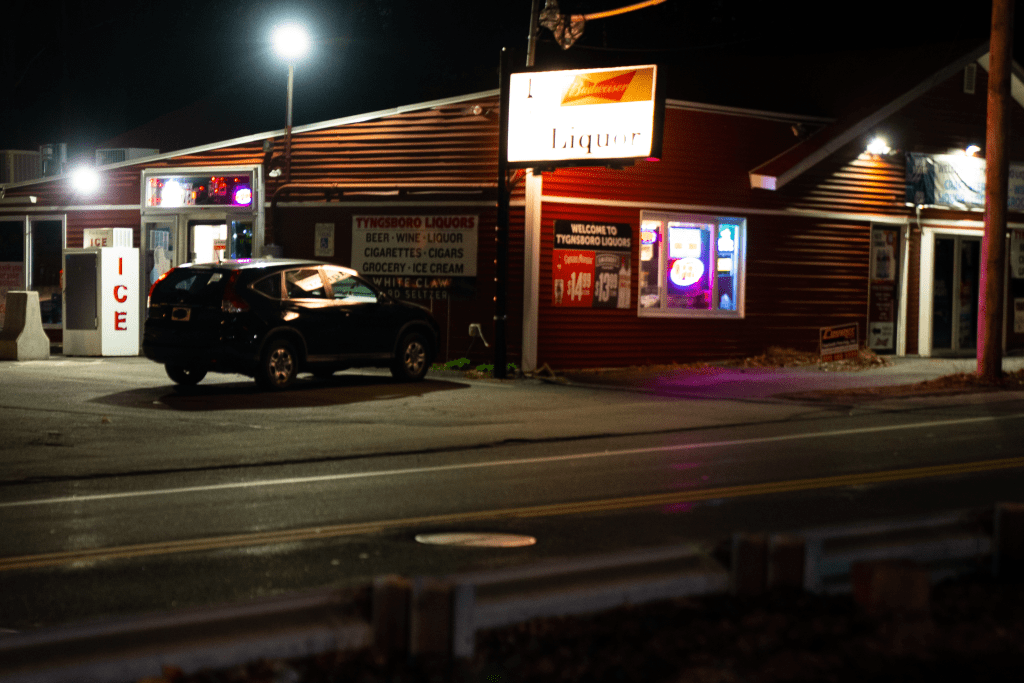
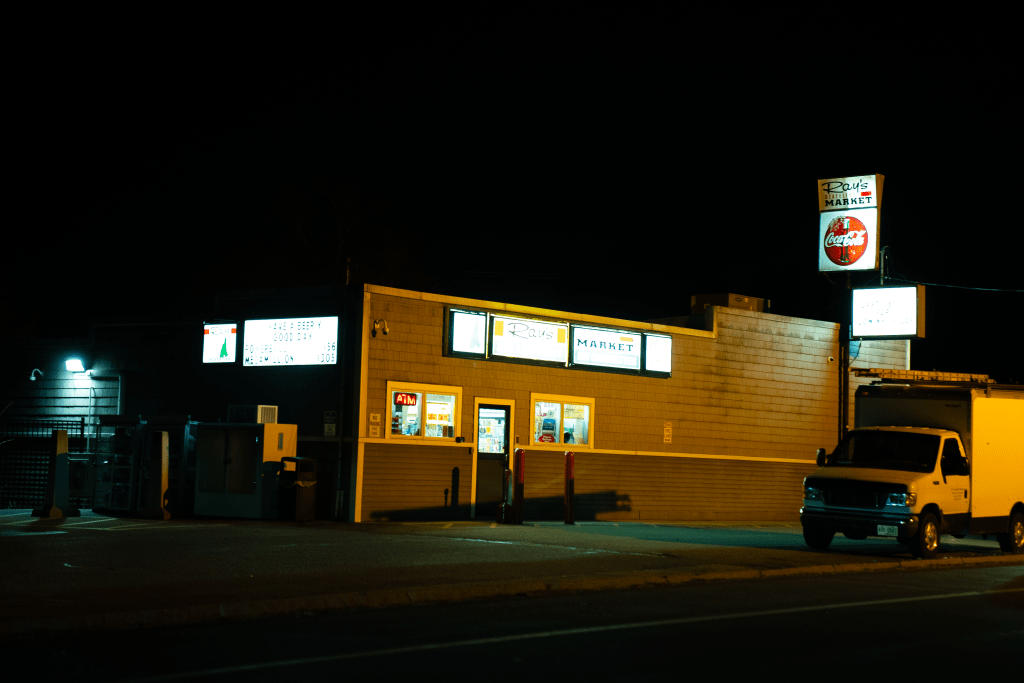
A dialogue, had between a Mapmaker and a Late Night Cashier, the former finding the latter outside the convenience store where they work at around 2 am on a dry Tuesday night/Wednesday morning.
Mapmaker: Oh, excuse me.
Late Night Cashier: Watch where you’re swinging that thing, hey?
Mapmaker: Sorry, I just wasn’t looking where I was going. I’ll be more careful next time.
If you look up above their heads, the chipping of ancient green paint on the bay windows of the old buildings creates an almost marbling effect, accented by the enforced monochrome of sodium-vapor streetlamps.
LNC: What is that, anyway?
M: Oh, this is just a ruler, essentially. It’s to measure distance.
LNC: You work for a construction company or something?
M: No, I’m a mapmaker.
LNC: Oh. How’s that going for you, now that Google exists?
M: I don’t like to talk about it.
LNC: But they don’t really need you to make a map of this city, do they? Because I can just pull out my phone…
M: They don’t need me to make it, but I’m here to truth it.
LNC: Excuse me?
M: I’m here to make sure that what they have in their map is true. I’m walking the streets with my measuring tool to make sure they’re actually as long as they say they are, that it actually takes as long to walk down them as they tell you it does.
LNC: And they pay you for that?
M: I don’t like to talk about it.
*

*
To say “that makes me think about x” is another way of saying “I see/suspect/detect a similarity between these two things.” If one is using the phrase earnestly and not as a way of avoiding one’s own conversational shortcomings, then you’d expect it to be followed up by an explanation of what the connection is that your interlocutor sees.
“… Which is why it’s taken me so long to do my taxes this year.”
“That makes me think about when my grandmother died.”
(long pause)
“She kept forgetting things towards the end, I mean. And sometimes I wouldn’t hear from her because it would take her a week to remember to call me back.”
When I was a first-year English major in college, my advisor told a class full of freshmen that whenever we said a piece of writing felt like it “flowed” well, what we were really saying, whether or not we knew it, was that it had well-executed transitions. If a reader or conversant can be adroitly moved from topic to topic, then they can either not notice what unstated ideas are forming the connective tissue, or they can come to understand those ideas with greater clarity than before.
*
They continue on along the street together, the Mapmaker walking his measuring tool in front of them like a dog.
LNC: So how accurate has it turned out the maps online are? In general.
M: In general? They’re usually pretty accurate.
LNC: So do you really need to be doing this if they’re already mostly right?
M: But if I wasn’t doing this, how would we know that they’re already mostly right?
LNC: (pause)(laughs)
M: You’re laughing at me.
LNC: No, I’m not.
M: Yes you are.
LNC: No, I’m sorry, I didn’t mean to make you feel bad. What you said just made me think about something a customer said to me tonight.
(Long pause)
LNC: He’s an old guy who comes in every night, always loud, probably drunk, goes down every aisle in the store and talks to me the whole way through like he’s narrating it all to me.
M: What did he say?
LNC: He said “Aw, c’mon now, without me how would you even get through the night around here? You love it when I stop by.”
M: And what did you say?
LNC: Nothing. I’m just trying to get through my shift.
They walk on in silence for a bit, the Mapmaker trying to figure out whether to feel insulted by this or not. It feels like they should, but the Late Night Cashier is still here with them, after all, and they’ve been walking together for a while now.
*
*
Ernest Wamba Dia Wamba writes the following:
The political attitude is not accommodating; the state of affairs in the world does not have to remain so because it is so. People may live differently than they live. Politics is not expressed through the spontaneous consciousness. It is an active prescriptive relationship with reality and not a reflection or representation in consciousness of invariant structures (economic structure or level of development or the state). Politics is a creative invention. Let us do something about the situation! characterizes a political attitude.
And Asad Haider glosses this like so:
Wamba emphasizes, drawing on Sylvain Lazarus, that “people think,” and that without this point of departure we inevitably end up in an elitist politics. Consequently there is a sense in which politics is thought—but thought is not, in some dualist framework, separate from reality. People’s thought is part of reality, and this is a materialist and egalitarian proposition. It rejects the idealist and elitist notions that “theory” is disconnected from people’s thought, and that only the party or the state can think. Emancipatory politics, then, based as it is on the “active prescriptive relationship with reality,” is not the expression of a social foundation. And because it starts from the premise of people’s equal capacity for thought, it is a mass politics—not a populist politics in the sense of “the people,” but simply generic “people.”
Asad Haider, Exhaustion and Emancipation
I, too, am ever wary of an elitist position. If I were to state the difference between the core assumption that animates what I’ve written here so far and the point that Haider, drawing on Wamba, is making, it would be that not only do people think, but that people think even when they don’t think they’re thinking.
But is this itself an elitist position?
*
The Late Night Cashier can run through the layout of the convenience store in their mind almost without having to think about it. They are so used to being there, and it’s a small store anyway: three aisles, a set of four refrigerator cases along the back wall, and a rack of magazine and newspaper publications on the far wall they face every night standing in front of the cash register behind a plastic-looking shield they’re told is bulletproof.
Aisle 1 – The usual snacks: packs and cans of chips, bags of pretzels and individually wrapped crackers-and-cheese segueing into more confectionary items like gumm(i/y) worms, bears, fish, on through chocolate-covereds and boxed jawbreakers and assorted “fruit-flavored” suckables, etc., etc. Most people coming in are either coming here or going past all three aisles for the refrigerators (see below).
Aisle 2 – Being in the middle, this is the only aisle with two sides. On one side, painkillers, allergy and cold medicines, antacids, toothpastes, floss and toothbrushes. On the other side, a small section for condoms and pregnancy tests that the old jackass the Late Night Cashier told the Mapmaker about finds consistently hilarious. The Late Night Cashier grits their teeth every time he reaches this section and waits for him to get past it, on to the hand sanitizer, tissues and alcohol wipes.
Aisle 3 – Junk: hats nobody would ever want to wear, baby clothing nobody should ever want to put on their child, combs that will break the second or third time you use them, charging cables and aux cords that probably won’t connect to the kind of port your phone has, whatever it is. At the end, a small, rotating rack of five dollar sunglasses.
Refrigerators – These don’t get dicey until the last two; the first two doors open onto 1) water, flavored water and seltzer, and 2) soda in its many varieties. After that is when you get into the beer, mostly big corporate brands like Budweiser and Coors, but a couple of scattered selections from small-time breweries in the area. The water is placed furthest from the front door, but the beer is what people come in for mostly.
Periodicals Rack – This is where a student comes in often to lurk, her hood pulled up over her head and back turned to the Cashier. “Student” is a title the Late Nigh Cashier has assigned to this regular because of the backpack she always carries, from which she once visibly removed several books. She will skulk and read for twenty-ish minutes on Mondays, Wednesdays and Fridays, which, if the story is correct, must be the days she has classes.
Bathroom – There’s one in the back that you have to ask for the key for. It’s not very nice, but it’s there, and the Late Night Cashier has never denied anybody the key; that would, as far as they’re concerned, be significantly above their pay grade.
*
Haider goes on to write that Wamba goes on to write:
Emancipative politics does not always exist; when it does, it exists under conditions. It is, thus, precarious, and sequential: it unfolds until its conditions of subjective break disappear. When people lose the consciousness of subjective break by ceasing to be involved in political processes, emancipative politics disappears. The completion of a sequence of progressive politics does not lead automatically to another. In the absence of emancipative politics, the state problematic or the imperialist influence prevails in the treatment of matters of politics. To reduce every political capacity to a state capacity is to abscond from politics.
To which Haider goes on to write:
Politics is not the political order of institutions. This much is already determined by the affirmation of people’s thought. But just as significantly, it does not always exist. When it does, it appears in sequences with a beginning and an end, and advances categories specific to its situation… In line with Wamba’s reasoning, Michael Neocosmos provides important developments in his aptly named Thinking Freedom in Africa. Depoliticization is “the inability to maintain an affirmation of purely subjective politics” when “state politics reassert themselves because of the gradual linking of politics to social categories.”
Asad Haider, Exhaustion and Emancipation
*
*
I think I’m not only trying to describe the way that emancipative politics happens, but also its opposite: active repression, yes, but in its greige, dull valence, its low-level-buzz-driving-you-crazy-unless-you-can-just-barely-stop-noticing-it variant. Garden variety. My worry about broadening the act of thinking to something which is done not even consciously is that I am either 1) failing to recognize sufficiently the active capacity of people to think, privileging instead the tendency to think passively (i.e., maybe, to be thought for), or 2) I am, in the unconscious of this argument, suggesting that structures do people’s thinking for them. That forces of habit and social pressures can be thought of as thinking. That highway patterns and graphic design think for people. That buildings think for people.
Does the supermarket think for me? I feel sometimes that it tries to. As in a casino, there are often limited windows onto the outside world so that if the sun sets and I’m still looking for the right can of soup, I don’t so easily realize that time has passed and I should be hurrying up. The milk, assumed to be something that most people are going to want to buy most of the time, is usually placed as far away from the front door as feasible so that I would have to walk by all the rest of the things I might not have realized I wanted to buy if I were to walk to it. And the music (Christ, the music) that they pump in certainly must have some sort of dark neurological effects; or at least I’m inclined to think so when waiting in the checkout line, especially during the Holidays.
But this, I should remind myself, is not “The Supermarket” thinking for me. It is somebody who designed the supermarket trying to think for me in concert with the people who own the supermarket and stand to gain from the habits this architecture encourages. And these are the patterns they have created to think for me resting on top of the patterns they have created to think for the people who have to work there, who are also, despite what these patterns encourage one to believe, active participants in this process. I will hazard a correction: to say that people think even when they don’t think they’re thinking can be a helpful statement, but only with the stipulation that the structures doing their thinking for them in the moments where they don’t think they are are also the result of other people thinking, at some point in time and some place in the world.
Which makes me think about what the similarities might be between States and Supermarkets.
*
But the Mapmaker and the Late Night Cashier have by now reached the edge of the city. Just sort of standing there, sharing an awkward silence, no longer sure where to go to justify their staying together and yet not wanting to part. They hang around without speaking for a socially inappropriate length of time. They are both too interested in each other at this point to just leave things where they are; there is too much they each still don’t know.
 Not Enough Time
Leave a comment